
Neil Rose reports from last Friday’s ACL Manchester conference, a journey from Tarzan to Magna Carta

It can feel like a jungle out there sometimes and last week the ACL plonked members right in one at the Treehouse Hotel in Manchester, which could only have leaned in more to its theme if it had allowed the speakers to swing onto stage on vines while yodeling like Tarzan.
So it was fitting that the opening, keynote speaker at the annual Manchester conference was that veritable big beast of the civil litigation world, Professor Dominic Regan.
He took a trot though the big costs and procedural issues of the moment, first highlighting the decision of Senior Costs Judge Rowley in JXX, concerning the need to break down medical agency fees.
He said the judge “has for years been begging for this to go on appeal” and looked like he would get his way this time. “Although there are whispers – and I put it no higher than that – that there might be a mediation between the parties on the basis that if it does go on appeal, then presumably, as ever in litigation, there’ll be winners and there’ll be losers.
“Whereas if we can have some sort of agreed arrangement as to what agencies could charge, then maybe everybody will be not exactly happy, but content that they’ve got an outcome. It screams, frankly, for some sort of joint approach.”
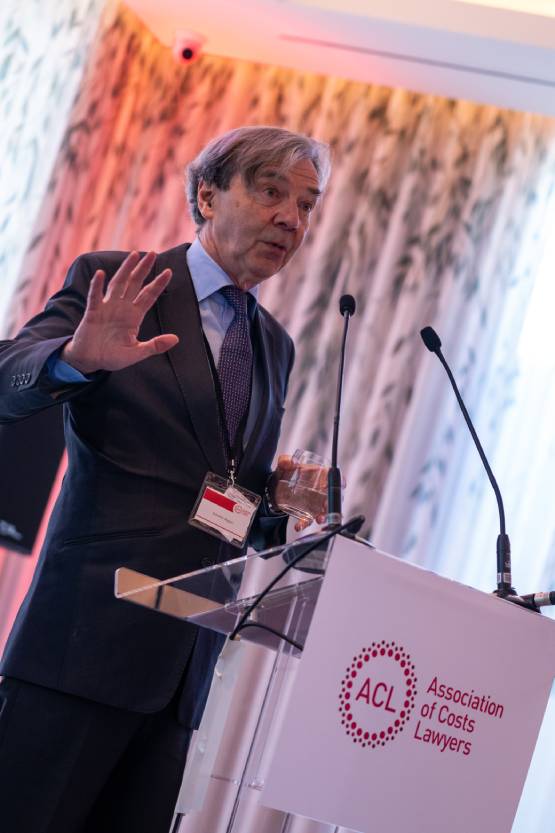
On budgeting, Professor Regan observed how directions and budgeting have become “uncoupled”. He went on: “That sensible because if you’ve got your directions first, you know exactly precisely what you are budgeting for.” Further, as cases in the last couple of years showed, budgeting was no longer necessarily a costs-neutral exercise.
Earlier this month, the judiciary-led disclosure review working group said it would consider simplifying disclosure rules for the Business and Property Courts after a survey found dissatisfaction with how they were working. “There’s a sense that it is unmanageable, it is out of control, it needs to be reined in and I think we are going to see that sooner rather later,” commented Professor Regan.
He referenced too the recent Gerry Adams litigation, in which the former Sinn Fein leader was sued by three victims of IRA bombs. Late in the case, the judge indicated that he wanted to consider whether the action was an abuse of process.
“Edward Craven KC took the hint and described the true purpose of the claims which were limited to £1 in vindictory damages was to secure a ‘public inquiry style examination’ of alleged IRA activities by the defendant over many years. Counsel noted that the evidence adduced amounted to irrelevant allegations that had no bearing on the three bombing incidents.
“This turn of events terrified the claimants. They had proceeded on the basis that personal injury claimants are protected by qualified one-way costs shifting so that if they lost a costs order could not be enforced against them.
“However, that protection vanishes if proceedings are struck out as an abuse of process. Given that the judge had raised the issue, it must have been something that he thought was at least arguable. Facing massive adverse costs liabilities, the claimants threw in the towel and agreed to a drop-hands offer made by the defendant, so each party paid their own costs.”
Mr Justice Nicklin has made a similar point about civil litigation not being akin to a public inquiry in the claim brought by Prince Harry and others against the Daily Mail. Professor Regan, who reckoned the newspaper would win that case, warned that abuse of process was “a fluid, wide open concept, so beware”.
More capacity at the SCCO
The conference then moved onto Costs Judge Nagalingam giving the Senior Courts Costs Office (SCCO) view on Solicitors Act assessments.
But he began by pointing out to delegates the recent appointment of Paul Joseph, a barrister who practised from 3PB, as a new SCCO judge, and said the final vacancy would be filled shortly, bringing the SCCO back up to a full complement by August.

He was followed by newly qualified Costs Lawyer Sarah-Jane Lewis from Peak Costs, who spoke about the next generation of practitioners.
The 26-year-old – who has already worked in costs for a decade – said: “Modern Costs Lawyers aren’t born with a perfect plan. They’re built over time through support, opportunity and experience.
“I’m sure we can all agree the profession has evolved dramatically and over the last 10 years I’ve seen that change. The route to becoming a Costs Lawyer is not one size fits all. There is space for individuals who didn’t go to university, changed careers, came in through apprenticeships or simply didn’t follow the expected path.
“That matters because now it means that more people in your firms and more juniors have a way of becoming successful lawyers. The ACL has played a massive part in that.”
Ms Lewis explained how the Costs Lawyer Professional Qualification not only provided knowledge and technical skills, “but most importantly, it has given us confidence – confidence to trust our own judgments, to speak up in discussions and to take ownership of our work. It’s given us a stronger understanding of why we do what we do, not just how we do it”.
She urged employers to help newly qualified Costs Lawyers “see that this is just the beginning, not the end. It’s where they will begin to shape their own approach, develop their own style and decide what kind of Costs Lawyer they want to be”.
She added: “Every single person in this room has a role in shaping the future of this profession. This is true when it comes to supporting junior colleagues, encouraging new entrants and just making the profession feel welcoming…
“Some things that make the biggest difference are taking the time to explain something to a student, giving someone reassurance, sharing your own experiences. How did you come into the profession? What things challenged you? What things helped you? Remind students that no question is a stupid question.”
Supporting students during exam season and helping them fill their qualifying experience records was also vital, Ms Lewis said.
She finished: “What I’d like you to take away from this talk today is: invest in the next generation of Costs Lawyers, give them the confidence to say that they can achieve it despite whatever background they came from, because modern Cost Lawyers aren’t born, they’re built.”
Simplifying part 36
After a talk on conduct and costs by Martyn Griffiths, a barrister at Gatehouse Chambers, there was the traditional Q&A panel.
The panel agreed with the first question of whether part 36 needed to be reformed to better complement the fixed recoverable costs regime. District Judge Richard Lumb, a regional costs judge sitting in Oxford, is a costs tutor at the Judicial College and noted that “it’s quite difficult to teach”. He continued: “If the judges who are teaching it have great difficulty in understanding it all, then it probably needs some degree of simplification.”
The discussion turned to the guideline hourly rates and whether, instead of a new methodology, there should be a return to the old A+B approach. Kevin Latham pointed out the historic problems the Civil Justice Council has faced in obtaining good evidence about rates but thought the current approach was as good a solution as was available, so long as the figures were regularly updated.
ACL Council member Nicholas Lee, managing director of Paragon Costs Solutions in Bristol, suggested that the questioner “is probably hoping the answer might be yes, because they would want to use the A and B factors to show that the cost of running business is rather quite high and therefore the guideline rates are comparatively low”.

While experienced costs judges would probably have a good grasp of those factors, it would be difficult for less experienced judges, he said. It would also be tough to do on a provisional assessment, given the time allocated for judges to handle them.
Sean Linley, a senior costs draftsperson and trainee Costs Lawyer at Carter Burnett, said the rise of remote working would also make a return to A+B difficult. Looking ahead to the greater use of artificial intelligence, he went on, time might not be the best way to judge the value of work done and should lead to a wider discussion about factoring in the cost of technology.
Devil in the detail?
The conference then split into three breakout sessions. I attended a judicial Q&A with DJ Lumb, Kevin Latham, who sits as a deputy costs judge, and His Honour Judge Adrian Bever from Manchester.
Among the questions was how detailed bill entries and the narrative should be. “I don’t read the narrative,” said DJ Lumb. “I read the papers.” HHJ Bever said: “For those people who don’t read the papers, the narrative needs to inform the judge of the 44.3 factors, essentially. They need all the background they can get.”
Kevin Latham said: “I tend to skim the preliminary issues in the PODs first and the replies, then go to the bill narrative, then read the PODs in more detail and then go to the file. The narrative, it seems to me, is written advocacy in a different form… It shouldn’t be entirely partisan, because the moment you start reading a narrative which is just so obviously one sided, you start to turn off and think, ‘Well, this is not a fair reflection of what happened’.
“So you should start from the point which is fairly factual, but it is an opportunity for some advocacy if you want to complain subsequently about the conduct of the other side. There are ways of presenting that information in a factual way without gilding the lily.” He added: “One thing which you don’t want to see is effectively a chronology in prose.”
Bill item detail was trickier. “There needs to be enough detail in there that you don’t have to go to every single supporting document so that the other side has some understanding. What’s unhelpful is when you just see letters but I tend to think bill items should be brief.”
DJ Lumb cautioned receiving parties arguing that the paying party’s conduct unreasonably increased the level of the costs to make sure that was borne out by the file. “I’m sick and tired, frankly, of seeing that as a sort of supposed justification for the costs being higher than you’d expect them to be. And when I read all the correspondence, I find that actually the people have been really unreasonable have been the receiving party. The paying party has been desperately trying to settle the case right from the start.”
Mr Latham said: “It’s astonishing how frequently you see, either in bill narratives or points of reply, almost emotional displeasure at a defendant’s approach when actually all the defendant’s done is deny liability. They’re entitled to do that… So don’t try and make a point out of something which isn’t really a point.”
HHJ Bever stressed the importance of making succinct points in provisional assessments, given that the judge only had 45 minutes to an hour to deal with it, and Mr Latham widened that out to say that “we’ve got into a situation where points of dispute and replies are overly verbose”. Practitioners should highlight key authorities and summarise the main points of relevance, rather than produce “pages and pages and pages of paragraph after paragraph of analysis of the authorities”.
Celebrity crushes
The afternoon started with ACL chair David Bailey-Vella making a presentation to mark the end of Kris Kilsby’s six years on the Council, and with a fiendish quiz devised by Nicholas Northrop – a mix of technical costs questions and surprising revelations about members of the Council.
Amelia Sanchez from Hill Dickinson and Fraser Barnstaple from Kings Chambers won and their prize was Costs Compass 2026, published by Class Legal and edited by David Bailey-Vella and fellow Council member Amy Dunkley.
It brings together all the essential costs, fees, cases, J-codes, rules and regulations that Costs Lawyers and litigators need in a single volume. ACL members can make a huge saving on this, bundled with the Costs Law Reports, by going to the member benefits section of the website.
We then moved onto more technical talks – Simon Browne KC of 12 KBW on probate, approval of costs settlements and 25 years of the guideline hourly rates, and John Meehan of Kings Chambers on how Smithstone v Tranmoor Primary School affected part 36 offers in detailed assessment proceedings – before Sean Linley turned gameshow host by asking delegates to identify the celebrities behind various costs cases, with small prizes for the winners.
He talked through the key issues in the four cases – Wagatha Christie case, as well as disputes involving Brian May, Jeremy Vine and cricketers Ian Botham, Allan Lamb and Imran Khan – before highlighting how many other costs cases involving celebrities there have been, including Prince Harry, Naomi Campbell, Noel Clarke, Sir Cliff Richard, footballer Danny Simpson, Chris Packham and most recently Banksy.
His favourite was Hugh Grant’s phone hacking case, in which the actor managed to distill his explanation for settling, namely the part 36 costs risk, into a single tweet.
“Suddenly we’re big news,” Mr Linley said. “I never thought I’d see the day when costs budgets were on the first page of BBC website.” Even if not all the headlines were positive, these cases served to raise the profile of the costs profession, aiding understanding of what Costs Lawyers do, attracting new talent and “reinforcing our status as specialist practitioners”.
He added: “And let’s be honest – don’t we all love a bit of show business?”
The access to justice conundrum
As winner of the Costs Lawyer of the Year Award at the Modern Law Awards earlier this month, ACL vice-chair Victoria Morrison-Hughes was given the last slot on the programme, which she used to talk about the fundamental issue underpinning what Costs Lawyers do: access to justice, a concept “fundamental to democracy and constitutional legitimacy”
She said: “Access to justice affects all of us, the whole of society – not just lawyers, but obviously as lawyers, we’re at the forefront of the access to justice campaign. Societies become unstable when people lose confidence in fairness, and there is international confidence and domestic pride in our UK legal system and we’re a part of that.”
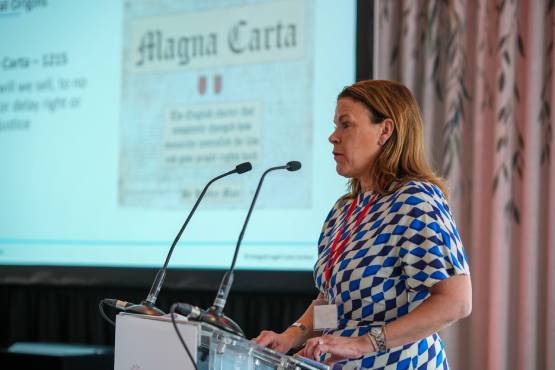
Ms Morrison-Hughes traced the core statement of principle back to Magna Carta in 1215 and pointed to the impact of legal aid cuts and how that has shifted the focus the alternative ways to fund litigation. But with funders tending to focus on bigger cases, “there’s a risk of excluding the lower-value but socially important claims”.
So what role do Costs Lawyers have in the access to justice campaign? “We’re the conscience of the profession, aren’t we? We see all the skeletons in the closet. Whether or not we can affect change is a different matter, but we definitely see things that could be done better and that’s part of the campaign in raising awareness around the costs disputes.
“[We] play a vital part in the access to justice debate. Our expertise and skills help to control costs, which is an access to justice issue of itself. We help frame and inform the discussion around proportionality, another key principle in civil justice. Unchecked litigation costs can deter valid claims.
“As Costs Lawyers, we should be proud of the fact that we operate at the intersection of fairness, economics, and procedure.”
The modern challenge, Ms Morrison-Hughes said, was “the tension between justice as a public good and law as a commercial commodity” – if access to justice depended entirely upon profitability, “then the rule of law itself may become unevenly available”.
She concluded: “In my view, access to justice depends upon affordable legal systems, ethical practice, independent courts, fair funding structures and proportionate legal costs.
“But increasingly as a profession we face threats from legal aid cuts, funders pulling out the market or failing, court backlogs and delay, rising legal costs generally and just general the fact that this is a money driven profession.
“I leave with a question to think about for yourselves: what part you can play in the access to justice campaign?”
The day finished, as usual, with newly qualified Costs Lawyers receiving their certificates from Costs Judge Nagalingam and Tracy Savage, the chair of ACL Training, before delegates retired to the bar for a well-earned drink.