
At last week’s ACL in Conversation event, Lady Justice Cockerill, the deputy head of civil justice, outlined how costs could be changing
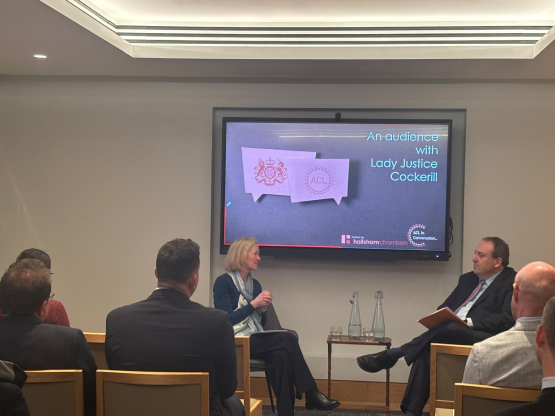
For Lady Justice Cockerill, becoming the first female deputy head of civil justice last November was a big moment. “I was of the generation where I thought there will be no more firsts for us by the time we got to the top of the profession,” she told last week’s ACL in Conversation event. “So it’s very nice for there still to have been one for me to pick off.”
She went on: “I think it is very important because it is a role which possibly has quite a male vibe to it. There’s a lot of committee business, core administration and so on. We have never really seen that area headed up by a woman.”
Speaking at the event, sponsored by Hailsham Chambers at Inner Temple, Dama Sara said she entered the profession just at the time when it was opening up to women. “When I came to the Bar, it was 50/50 women and men going into the legal world. And we imagined that by the time we reached the stage of becoming partners and taking silk, it wouldn’t be an issue anymore.
“But when I took silk, I looked around and wondered ‘Where did everybody go?’ Because there were so few of us making it through. I really started to think that maybe this was a lost cause, but there have been huge strides in the last 10 years or so.
“There’s been a huge culture shift, certainly amongst men at the Bar, in terms of their willingness to participate in childcare and so on. We are now seeing so many more female silks and partners coming through, and so many more people from minority ethnic communities making their way to the very top level. So hopefully we are finally getting the progress we’ve been looking for so long.”
She demurred when asked about last year’s Harman report, which painted a less rosy picture of how women and ethnic minorities are treated at the Bar, given the work for the judiciary that it also highlighted. But she did note: “One of the things that constantly surprises me is that, however much work we do, messages get lost if we don’t keep coming back to them and keep communicating the good things we’re trying to do.”
Indeed, the greatest challenge she had in pursuing a career at the Bar was from her family, of which she was the first member to go to university. “When I told my father that I wanted to become a barrister, he told me, ‘Don’t be so stupid. People like us don’t become barristers’,” Dame Sara recalled. “So I had quite a challenge in gaining the courage both to come to the Bar in and of itself and to contradict my parents in what they thought was a complete waste of time.
“My father actually got a friend of his to sit me down and explain what the Bar was like and how it was full of people who wouldn’t let anybody in who weren’t male, hadn’t been to public school and didn’t have relatives there. But I’m the kind of person, who when somebody tells me ‘You really can’t do that’, I’m prone to dig in my heels and say, ‘Well, we’ll see about that’.”
She was called in 1990 and joined Essex Court Chambers (then 4 Essex Court) in 1991. She practised in commercial cases, taking silk in 2011, before joining the High Court bench in 2017. Having been judge in charge of the Commercial Court from 2020 to 2022, last October saw her elevation to the Court of Appeal.
And as if that was not enough, she is also an author on medieval history, having written Eleanor of Castile – The Shadow Queen and Eleanor of Aquitaine – Queen of France and England, Mother of Empires.
Digital priorities
The deputy head of civil justice is a busy role but Dame Sara said she has priorities. One is the transparency and open justice board, of which she is a member, about making the courts more accessible to the press and public. This has made good strides, she said, and was intrigued by the suggestion from the floor by ACL Council member Amy Dunkley that costs pleadings be made available under the pilot as a way to build the evidence basis for guideline hourly rates.
(She knew from personal experience that asking busy judges to fill out forms after cases concluded was not an effective approach.)
Digitisation and the work of the Online Procedure Rule Committee are also high on the agenda. “The system has to modernise,” she said. “But as we’ve all discovered, for example, with NHS digitisation projects and with our attempts to digitise thus far, these very big systems are not easy to change.”
Part of this is also stripping back the rules to make modernisation easier and justice more accessible.
“A lot of the online systems are designed to be used ideally by litigants in person on their mobile phones. Part of [Master of the Rolls Sir Geoffrey Vos’s] vision is that people will interact with the justice system on digital devices, and the statistics are proving him right – the percentage of people who will respond to a claim made in that way is higher than for the paper equivalent.
“So will we get very different rules? That is the ambition but the devil is in the detail. We’re just finishing the drafting of the core OPR rules and it’s very difficult to draft rules that are both clear and authoritative, while covering everything you need them to cover and being accessible.”
This work will filter down to the other rule committees and Dame Sara revealed that the Civil Procedure Rule Committee has decided to revive its simplification project.
The costs agenda
Inevitably, costs will form a significant chunk of her work, as they did with her predecessor Sir Colin Birss, now Chancellor of the High Court.
Dame Sara said the Civil Justice Council (CJC) working party on reform of the Solicitors Act 1974, headed by Mr Justice Adam Johnson, would be publishing its report very shortly. This is considering recommendations for primary legislative reform to the Solicitors Act 1974; the use of a general order under section 56 of the Solicitors Act 1974 to support the development of a more effective scheme for non-contentious costs; a potential costs regime for online digital portals; and the scope of future reform in relation to contentious and non-contentious costs.
“The legislation hasn’t really kept pace with developments and the status quo has made everybody very unhappy,” she acknowledged.
Also coming soon is a CJC report on guideline hourly rates for barristers and the new London 1a band for extremely complex, high-value litigation. “I think in some ways that this has been more contentious than the Solicitors Act, even though it’s less complicated. Guideline hourly rates for barristers was a bit of a shock to a number of people, but the CJC has managed to get some very good data to consult on.”
Dama Sara acknowledged there was “a degree of contention” about whether having the London 1a rate was a good idea or whether it would drive costs upwards. One contributor from the floor expressed concern that it would become a floor, not a ceiling. “Again, it has been quite difficult to get the data but there is now a sufficient basis to consult on the top rate,” she said.
It may be a controversial question to ask at an ACL event sponsored by a set with a leading costs practice, but do we spend too much time on costs?
“We all know that, in some respects, clients care more about the costs than they do about the outcome,” the judge replied. She recounted Mr Justice Foxton’s efforts in the Commercial Court to require juniors to handle costs, as a way to give them advocacy experience.
“This produced a violent reaction on the part of a lot of clients, who wanted their best advocate to do the costs because it is the area where (a) they care the most and (b) really experienced counsel who can speak to the judge with a particular amount of experience can sometimes get you a result that junior counsel can’t.
“So we ended up seeing people threatening to disinstruct junior counsel if they were going to be made to do costs. Hopefully these reforms, if they happen, will help.”
Dame Sara also took on board the longstanding request from Costs Lawyers that they should be included in the guideline hourly rates, like the other regulated professions.
Somewhat more successful are the costs budgeting lite pilots. They began on 6 April 2025 in the Leeds, Manchester and Rolls Building BPCs, and for business and property work in the Leeds, Manchester and Central London county courts. While not all rule committee pilots attract interest, this one has.
“It has been very, very popular amongst judges and, outside of London, it has been very, very popular generally. We have seen suggestions that people are issuing in locations where they can access cost budgeting lite rather than in the other district registries. You can anticipate that it will be brought back to CPRC with a view to wider rollout, certainly across district registries.”
Dame Sara acknowledged the view that it takes as much time to draft a lite budget as full one, but “it is cutting down on cost management hearings and will cut down ultimately on cost”. She urged practitioners to provide the rule committee with feedback to inform its decision on expanding the pilots.
While the judiciary is keen to encourage ADR wherever possible, the judge felt that “the fact of people feeling so very passionately about costs is one reason why ADR is probably less likely to gain traction”.
“You get a lot of costs bills agreed quite early on without the need for ADR on the whole, because you have Costs Lawyers on either side who can have a look at it and give you an idea. Once you get to the point of it getting anywhere near the costs judge, people’s views are probably polarised to an extent that settlement is unlikely.” Certainly, mandating ADR was unlikely to be fruitful, she said.
Dame Sara was also asked about whether Costs Lawyers should be eligible for judicial appointment. “The question of what the qualifications are for judicial appointment is not a matter for me, but if you can say that Costs Lawyers can fulfill what’s in the Judicial Appointments Commission’s skills and abilities framework, you’ve got a basis for saying to them that they should be.”
The AI challenge
The recent case of a witness caught receiving prompts via his smart glasses has highlighted the increasingly intrusive role of new technology in the courts. Dame Sara was positive about how ChatGPT and the like have helped litigants in person “produce a really rather decent pleading or witness statement”, making their cases easier for judges to deal with, even while having to be on the look-out for hallucinated authorities.
There is a CJC working group looking at use of AI in legal proceedings “but we also have a cultural and generational shift where people don’t necessarily see it as part of part of our remit to govern their use of this. So , whatever we do as the judiciary or as rulemakers, we are going to be dealing with people using AI in ways that we have not permitted. How we develop AI systems to scan documents to spot AI is one thing. How we use AI profitably to help us do our job is another.”
She has used AI to understand long email chains quickly, to digest information for referencing in a speech and, most interestingly, to draft a press summary of a court ruling. She was impressed with how good a job it did. There were three errors that she picked up in reviewing it but “the press office actually got a thank you from the press for a particularly good summary”.
Dame Sara has not used it to help with writing a judgment – “A number of people I know have tried it to produce a snappy and accurate summary of an uncontentious legal principle, but I think largely out of curiosity to see just how close it comes” – and frankly has not intention to. “I think a lot of us are control freaks about our writing. I identify more as a writer than as a lawyer, so I’m going to be very slow even when they tell me, ‘You must write your judgments by AI’. I’m going to be one of the holdouts.”