
Lady Justice Cockerill talks up role of Costs Lawyers in speech to ACL London conference
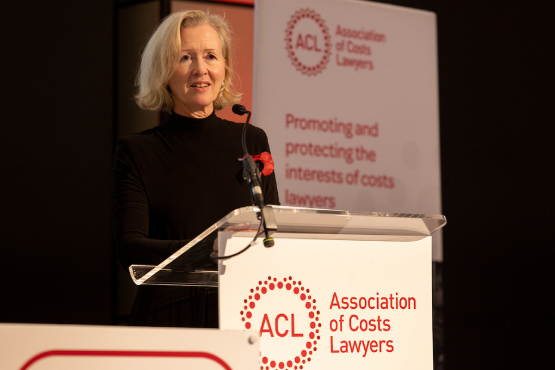
The deputy head of civil justice used her keynote address to the ACL London conference last week to back the call by the Senior Costs Judge (SCJ) for a review of the electronic bill of costs.
She made the comments in a speech which highlighted the role of Costs Lawyers in the justice system and in shaping its future.
As we reported last week, SCJ Jason Rowley told an ACL roundtable that the bill tended “to slow down how much you can get through in a day” and said that, after a decade of use, it should be revisited.
Speaking at last Friday’s ACL annual conference in London, Lady Justice Cockerill, the deputy head of civil justice, said that “in some respects and on some days” the electronic bill achieved its aim of allowing much better analysis of the work claimed.
“The ability to interrogate data can be extremely complicated in the right case, but the ability to interrogate data is not quite the same as the ability to understand it. And there is a risk that we give the reader every single possible piece of information and make it harder to see the point.
“So an effective bill is generally going to have to be something a judge can assess, a lawyer can challenge or defend and a client begin to comprehend.”
She went on: “A decade of experience of the bill is a perfectly sensible reason and point at which to ask what works, what doesn’t work and what a better approach must look like.
“We should be prepared to learn from those who use the system every day, including the people who find it difficult.”
In her speech, Dame Sara recalled how, when she was in practice, she never considered it “satisfactory” that costs were largely ignored until after the substantive case had ended. “I was regarded as something of an eccentric in that, from an early stage, a consideration of costs informed part of my analysis of the merits and quantum.”
This probably explained why a lot of her cases settled before trial and her nickname in chambers was “the settlement fairy”.
“The division between substantive issues and costs, which seems slightly artificial to me even then, is very obviously artificial and unsatisfactory now,” she went on.
“Your job is to understand what happened or is to happen in the litigation, to understand the procedural framework, to make difficult judgments about what is reasonable. And of course, as my own experience and practice showed, very often your skills are actually vital to help people arrive at an agreement rather than fight another expensive dispute about the expense of the first one.
“That requires legal knowledge, commercial realism, and I suspect a fair degree of courage. It also requires the ability to tell a client or another lawyer something they may not much want to hear… Often you work at the point where legal principle meets the reality of paying for the law.”
Dame Sara talked about her experience of the Pan-Nox litigation, which has so far involved two major costs management hearings – one handled by her with SCJ Rowley as assessor – that led to huge reductions in the claimants’ massive budgets.
“I can still recall the absolute horror that I felt when it was explained to me that my great plan of informal Friday morning meetings, the regular so-called management meetings by which we kept the juggernaut on the rails, had created the following situation: claims of £85,000 for one party to attend each meeting.
“The explanation of that was broken down for me forensically into an eye-watering eight stages, ranging from preparing for the pre-progress meeting to the post-progress meeting debrief. So that groundedness in reality and the practical consequences of what litigation can sometimes involve is one reason I think that your specialist advice and advocacy and costs are an essential part these days of an effective civil justice system. You’re not a slightly technical extra attached to it.”
Th judge acknowledged the challenges Costs Lawyers have faced in recent years but said “you probably now accept that the worries that you had that fixed recoverable costs would decimate the industry were ill-founded”.
She explained: “They are not easy on so many levels, but they do serve an important objective. Parties should be able to predict as far as possible the financial consequences of litigation. And yet we see predictability is not a magic wand which removes the work involved. You are, after all, growing and thriving despite fixed recoverable costs.
“And while process is simplified, it may mean that your advice is needed earlier and in a different form. What is the realistic exposure? Is a proposed step proportionate? How should a case be staffed? Is the point worth pursuing? What can be settled by when?”
Turning to the costs budgeting pilots, she said the attraction was “obvious” but accepted that even if the form was shorter, “the process is still no cheaper if what you’re doing is simply pushing all the work behind the scenes”.
“Equally, the detail which is reassuring to a cost specialist may not be the detail which helps me decide what is proportionate. So we must test what happens in practice and not simply think that simplification, the fewer number of boxes on a form is a win.”
She went on: “We need to look at the measures of success in a way which is quite hardheaded and intensely practical. Are the budgets prepared at less cost? Are the hearings shorter? Are the figures realistic? Do they assist sensible settlement? Do they still give both sides the fair opportunity to explain their case?
“I don’t have the answers. You’d be pretty surprised if I did, but I do have a very strong view that we must listen to the experience of you who prepare, challenge and argue budgets as well as those who decide them. And that is a very important practical contribution that you can make.”
Dame Sara did not intend to prejudge the outcome of the Civil Justice Council consultation on part III of the Solicitors Act but said “the underlying problem is a real one. If the amount of dispute is modest, we need to think very carefully about processes which can cost more from the dispute they’re meant to resolve”.
She explained: “If the client is vulnerable, has little understanding of legal procedure, a remedy which is formally available is not necessarily practically an accessible one. And of course there is the balance. Clients need that clear information about what they may be charged and what may or may not be recovered. Solicitors for their part need a workable regime in which legitimate fees can be pursued and disputes resolved.
“Not every dispute about a bill reflects misconduct. That is far from the case. Not every client is in a position to navigate a highly technical assessment. So we have to find a process which is fair, intelligible and proportionate for both sides. Costs Lawyers who see these disputes in their most practical form have so much to contribute to this conversation.
“I’d go perhaps one step further. Costs information ought to be comprehensible before proceedings begin, not only when the relationship is broken down. Always, of course, there are cases where a precise estimate is impossible and you know that best than I do, how quickly an opponent can make one impossible.
“But communication about risk and about the point at which a case is no longer economically sensible is an important part of the service. This is good litigation management as well as consumer protection.”
On AI, Dame Sara said she understood why it might look “rather threatening”, but that just meant “we need to think about and distinguish the task from the skill”.
“There may be less value in producing a first draft of something which a machine can generate. There is still very substantial value indeed in knowing whether it is right. Those are not questions answered by being able to fill in a form or push a button. They are questions of judgment. And as costs become more closely connected to active case management, those are the questions which we need answered before the end of the case and not just afterwards. And no machine can do that.”
AI could identify a time entry and assign a category but it could not say that the work was necessary of why that category was appropriate in this particular piece of litigation. “It can produce a really smooth, slick paragraph about proportionality. Has it actually understood what was at stake in the parties? Sometimes of course it will actually appear to have done all these things rather well and the difficulty is knowing when it has not.”
Equally, she accepted that changing the method of producing legal work meant a conversation about how the value of that work was measured and charged. “And there is such scope here for skilled Costs Lawyers to help lead that conversation with your expertise as you have it in the value of particular facets of work.”
It may be a period of great change but “one of the lessons that I’ve learned in this first year as deputy head of civil justice is that the best changes start with the people who actually do the job, explaining in sometimes painful detail how it is done. Theory is helpful, but theory only gets us confused in the end. Practical experience is indispensable.”
The result needed to be a costs system that “tells the parties what they need to know, allows judges to manage litigation properly, and gives the public confidence that access to court is not reserved for those who can afford an unlimited bill”, while not consuming a “disproportionate share of the case” or producing unfairness.
Next year’s 50th anniversary of the ACL was “a great opportunity to look back at how much the profession has changed since 1977. And it’s an exceptionally good place from which to ask what it will be doing in 10 or 20 years from now…
“My message is one of cautious optimism. You have adapted repeatedly and the complexity of litigation has not gone away. You have adapted to that complexity and helped to drive change. The challenge now is to use your expertise to make the system where you intersect with it better.
“Simpler, where it can be simpler, more transparent, where it needs to be more transparent, always alive to the price which court users actually pay. I’m entirely confident that you will play a key role in helping us to do that.”